54: The End of an Era
Before we begin, I have a very special announcement. I finally have a new job. Where? Gustavus Adolphus College, in St. Peter, Minnesota, just south of the Twin Cities. When? Mid-August. What is the job? I’ll be a visiting assistant professor in geology, just like my old job. It’s not permanent, but it’s right in my wheelhouse. I’m very glad to be employed once again.
This episode’s name has a few meanings. It’s the end of our grand Greenland arc, and it’s the second-last episode of Season 2, but it’s also the end of my time here in Michigan.
I came to Grand Rapids in 2022, to start a new life as a professor at GVSU. I learned how to be a teacher here. I learned how to mentor students here. I also carved out a fulfilling personal life in Grand Rapids, with the best girlfriend and many, many excellent friends. I would have loved to stay, but I knew the chances were slim. My position was visiting, and I can’t give up a career that I love, that I’m good at, and that I’ve spent nearly 20 years doing. It’s the end of an era for me: four years of joy and love, but it’s time to move on.
I’m looking forward to the next era, and to working at Gustavus Adolphus College.
With that in mind, the show must go on.
At long last, we’ve reached the end of our Greenland odyssey. The journey started way back in Episode 36: The Ghosts of Greenland. Here we are, 18 episodes later. One-third of this show has been spent on these frigid rocks. For reference, we only spent 3 or 4 episodes on previous locations. In the future, we probably won’t take this much time on other places, though no promises. Why did we linger so long here?
Before Greenland, our locations were small and separated by vast gulfs of time and space, easy to summarize in a few episodes. After Greenland, rocks will become more abundant and diverse, with stories happening around the world at the same time.
Greenland represents a tipping point: our first truly massive location, and the last stop on our neat, linear journey before the road splits up around the world. Greenland also introduced many new concepts and debates, crucial ones for later seasons: the different stages of metamorphism, the oldest remains of Earth’s mantle, the debate over early tectonics, and the many debates over early fossils. So while I could have trimmed an episode here or there, I truly think we spent as much time as necessary on the tundra. Which brings us to today. Let’s finish the story.
As we’ve seen, Greenland has a staggering diversity of rocks: dark basalts from undersea volcanos, pale ashes from volcanic islands, bratty dolomites on the seafloor, even slices of the mantle, among many more. These rocks formed in different places at different times, between 3.9 and 3.7 billion years ago. On our imaginary Earth Calendar, that’s February 25 to March 14, three full weeks. It’s been a grand party.
Today’s episode will move forward in time, ending 3.6 billion years ago, March 19. We’re done with lavas, done with seafloors, and done with fossils. Today is a tectonics episode. It’s time to take all those rocks we’ve met and smash them into mountains, into the contorted jigsaw puzzle on the modern Greenland tundra. Today, we learn how that tectonic squeezing happened, bringing our long party to an end.
Intro: The Shattered Planet, Revisited
Why should we care how the Greenland rocks met their fate? Sure, it provides closure for our long odyssey, but what does it matter to you or me?
Two words: plate tectonics. Nearly every mountain and ocean on Earth was forged by plate tectonics. Earth’s surface is broken up into dozens of plates, slowly but constantly pulling apart or smashing together. Plate tectonics explains earthquakes and volcanos and why Australia has kangaroos. Plate tectonics is a bedrock idea in modern geology.
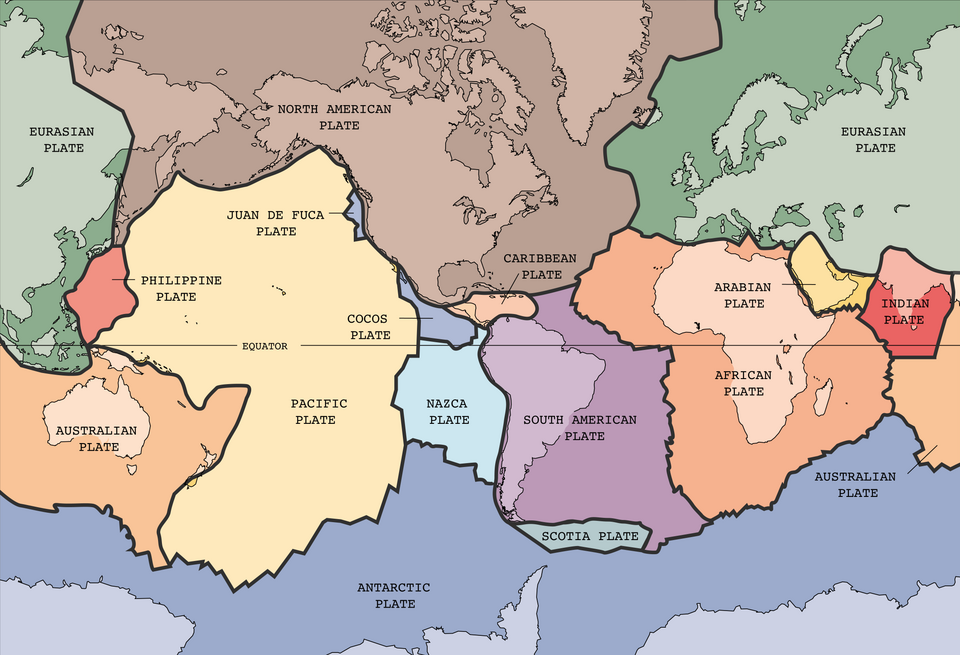
But how and when plate tectonics started is perhaps the biggest debate in modern geology.
It’s the cornerstone of our world, but its origins remain very murky. This is not our first tectonic tango on the show, nor will it be the last. Pick any date between 4 billion and 1 billion years ago, and you’ll find a researcher who thinks tectonics started then. For reference, that’s between February and September on our Earth Calendar.
If you’re still apathetic, here’s an analogy. You might find yourself behind the wheel of a large automobile. Or in a beautiful house. You probably know the basics of your car or building, how to drive it or keep it clean. But you might not know when it was built, or how the pieces came into place. That’s OK for now, but there might come an emergency when you really wished you knew how your car or building actually works on a deeper level.
The Earth is our home, our vehicle speeding through space. We know the basics of plate tectonics, but geologists want to know: Well, how did we get here?
That question becomes even more pressing when we look around the solar system. It would be really nice to have another planet with plate tectonics to compare with, a pristine “user’s manual” for Earth’s early days. Tough news, bud: no other world we know has plate tectonics like Earth. None of them, not even our neighbors Venus or Mars. Instead, these worlds have a single, solid sphere of crust, not shattered into moving plates like Earth.
These other worlds are called “stagnant lids”. Instead of plates moving horizontally like lily pads, they’re dominated by volcanos punching up from deep below, like Hawaii. Consider it an alternate way of running a planet. If you want to learn more, check out Episode 39: The Shattered Planet. In that episode, I introduced the great debate about early tectonics, about stagnant lids vs mobile plates.
Here’s what most scientists agree on: Earth’s probably started with a stagnant lid like Venus or Mars, and at some point transformed into the mobile, plate-tectonic world we love today. The questions are: how and when. We aren’t going to definitively answer those questions today for the whole Earth, but we’ll use Greenland to gather clues.
In Episode 39, we examined the beginning of Greenland’s story through the lens of early tectonics, and didn’t reach a definitive conclusion. Today, we examine the rest of the story through the same lens, and hopefully reach something more concrete.
There are three teams with very different ideas about how the Greenland rocks were built and deformed. I’ll give a very quick summary here, then we’ll get into the specifics, one section for each team.
Team 1: Hailing from Japan, this team says ancient Greenland behaved like the modern Earth. Basically, the more things change, the more they stay the same. Team 1 notes similarities between ancient Greenland rocks and modern rocks near deep-sea trenches, where one plate is shoved beneath another.
Team 2: Hailing from Australia, this team says ancient Greenland was similar to the modern Earth. Maybe not exact, but very close. Teams 1 and 2 agree that one pile of rock was shoved beneath another, BUT they disagree on the direction. Team 1 thinks northern rocks were shoved under southern ones, Team 2 argues for the exact opposite motion.
Team 3: Hailing from Germany and Hong Kong, this team has a completely different idea. Team 3 says that ancient Greenland behaved more like Venus or Mars. No trenches, no collisions north or south, just material bubbling up from deep, deep underground.
In short: Teams 1 and 2 agree on the broad processes, but differ on the directions. Meanwhile, Team 3 has its own very different ideas. Let’s see what evidence they all have.
Part 1: Scraping By
Each of our teams has many researchers playing different roles, with one or two consistent people leading the way. Team 1 has two major players, both from Japan: Shigenori Maruyama from the Institute of Science Tokyo and Tsuyoshi Komiya from the University of Tokyo. Both men are well-established researchers, publishing dozens of papers with hundreds of citations. We will see Maruyama and Komiya again in the future, all the way until the final season. In the interest of time, I’ll leave biographies for another day.
Team 1 proposes that Greenland 3.6 billion years ago was very similar to the modern Pacific. At least, tectonically speaking: no delicious fish, no majestic whales, and no oxygen. But deep, deep on the seafloor, similar tectonic engines were churning. What were those engines, and what is their evidence?
Let’s start with the modern Pacific. The Pacific is lined with many deep-sea trenches, like the infamous Mariana Trench, the deepest spot on the modern Earth. We’ve seen trenches many times on the show, but here’s the summary:
There are two types of crust on Earth: thin sheets of dense ocean crust, and thick blobs of lighter continental crust. When ocean crust crashes into a continent, the seafloor will get pushed down into Earth’s mantle, far below the Mariana Trench. For a similar effect, take your hand and slowly shove it below another object: a blanket or a table. Your hand sinking down is like the ocean crust plunging into the mantle. Where’s the trench? It’s the thin crack between your hand and the table or blanket. The trench is very deep to us humans, but it’s just scratching the surface of a much deeper struggle.
Trenches are a key feature in modern tectonics. You can only form a trench when two different plates crash into each other. You can’t form a trench on Venus or Mars, worlds with single stagnant lids. In short, Earth is the only planet we know where you could make the Mariana Trench. But was that true 3.6 billion years ago? If we find evidence for trenches in ancient Greenland, that’s very, very strong evidence for modern-style tectonics. Team 1 says they have that evidence, so what is it?
To explain, let’s return to our hand experiment. This time, I want you to put on a long-sleeved shirt, one that reaches to your wrist. If not, you can imagine with me. Just like last time, gently shove your hand below the table or blanket. Your shirt fabric should bunch up on your arm as your hand plunges down. Something similar happens at a real trench.
In this experiment, your hand and arm were the ocean crust, just like before. Your shirt represents the uppermost layers of mud and lava on the seafloor, the loose stuff you can see from a submarine. As the crust gets pulled down into the mantle, that surface material gets scraped off on the edge of the trench, left behind. Just like your shirt, that material begins to pile up on itself, forming a pile of seafloor leftovers. Geologists have a name for these deep-sea scrapings: an accretionary wedge. Accretion simply means building up over time, and wedge means something forced between two objects. In everyday English, an accretionary wedge forms as the seafloor gets scraped to the surface next to a trench.
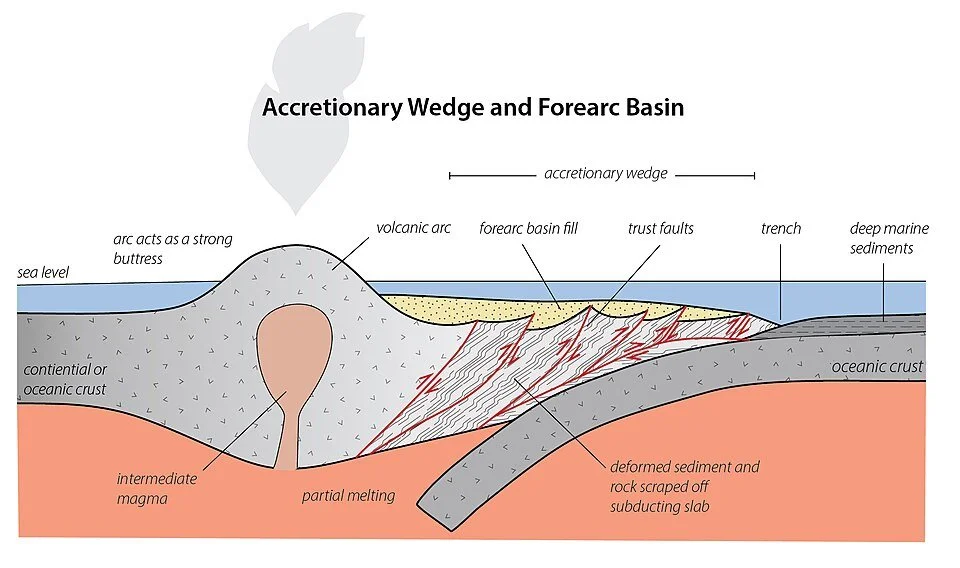
All this scraping might sound chaotic, but there’s a specific order to the rocks inside an accretionary wedge. Think of it like a three-layered cake. You start with dark volcanic basalt, the basement of the ocean. Then you move up into chemical sediments such as our old friends chert and dolomite, materials that gently settle down onto the seafloor. Finally, you have sands and sometimes even pebbles, larger grains dropped in from the coasts. If you look at a modern accretionary wedge, you’ll see this pattern repeated with each scraping: lava, mud, sand, scrape; lava, mud, sand, scrape.
Let’s bring this idea back to ancient Greenland. Team 1 claims that you can see the same pattern 3.6 billion years ago: lava, mud, sand, repeat. Team 1 has a lot of expertise in reading these patterns: their homeland of Japan is built on many such accretionary wedges, on the edges of massive trenches.
One last piece of evidence, then we’ll move on. Let’s return to our hand experiment one more time. You don’t need a long-sleeved shirt this time. As you shove your hand deeper below the table or blanket, imagine your fingertips going deeper and deeper into the Earth. Your fingertips would experience titanic pressure and temperature as they continued to crash forward. Meanwhile, your upper arm is relatively unaffected. You would expect the same pattern of stress in ancient Greenland: rocks closest to the trench would be very metamorphosed, while rocks farther away would be less altered. This is exactly the pattern described by Team 1 in 2015: clear zones of increasing metamorphism.
To recap Team 1’s argument: they claim that ancient Greenland was like modern-day Japan. A piece of ocean crust was sinking deep into the mantle, forming a deep-sea trench. Along the way, the top layers of seafloor were scraped into an accretionary wedge, showing us all the fossil candidates we saw in earlier episodes. Now let’s hear from Team 2.
Part 2: The Opposite Direction
As usual, let’s start by naming the major players on Team 2. These are old companions of the show, ever since Episode 40: Allen Nutman, Clark Friend, and Vickie Bennett. They’ve been in every major Greenland debate, from the early mantle to the earliest fossils. What do they have to say about the early tectonic debate?
Here’s what Team 1 and Team 2 agree on. Both teams agree that some form of modern plate tectonics was happening in ancient Greenland. Both also agree that one slice of Earth’s crust was being shoved beneath another. The biggest difference is the direction of that shoving. Team 1 thinks the north half was shoved under the southern half. Team 2 thinks the exact opposite: the south was shoved under the north.
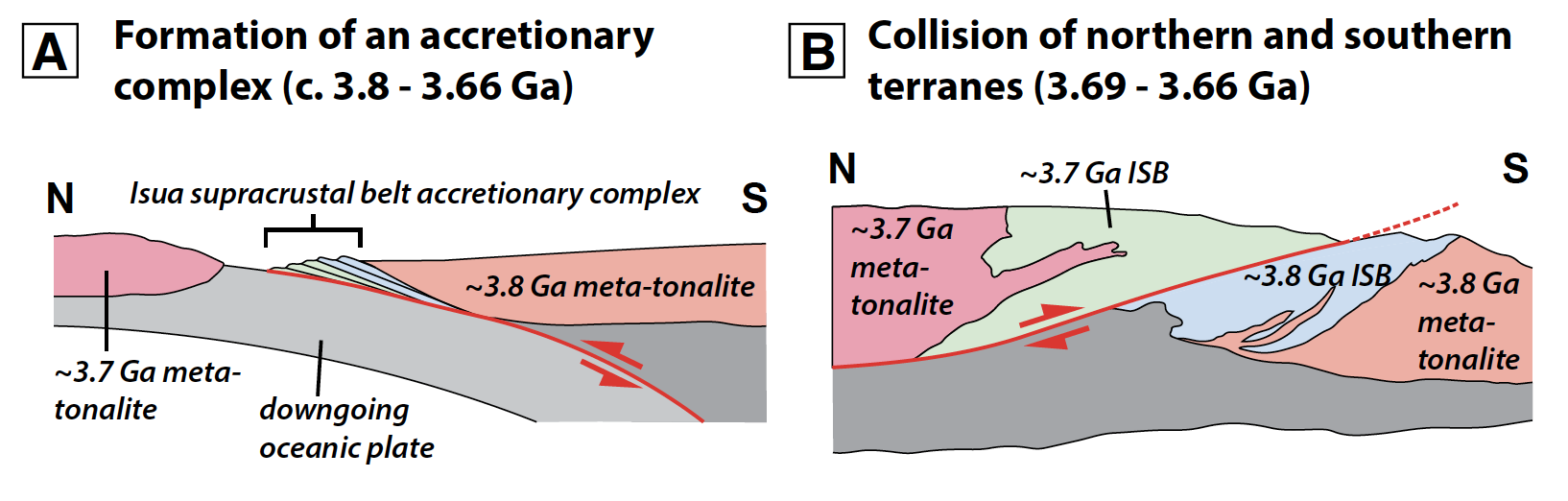
Comparison of Team 1’s subduction model (left) with Team 2 (right), with North and South shown. Trench motion shown in red. From Webb et al., 2020
I’m honestly not going to spend as long with Team 2 as Team 1, since their ideas are so similar. In fact, reading their respective papers, the teams rarely seem to attack each other, which is a rare truce if you’ve listened to all of our Greenland episodes. But there are a few differences worth mentioning.
The biggest difference is what data the teams emphasize. Team 2 focuses on the ages of rocks in different parts of Greenland. We’ve already seen this in previous episodes: broadly speaking, the older rocks are in the south, and the younger rocks are in the north. The age difference is significant: northern rocks are ~100 million years younger than southern ones, roughly a week on the Earth Calendar, March 3 vs. March 11. Team 2 argues the age gap is too large to explain with a simple accretionary wedge, which was Team 1’s explanation.
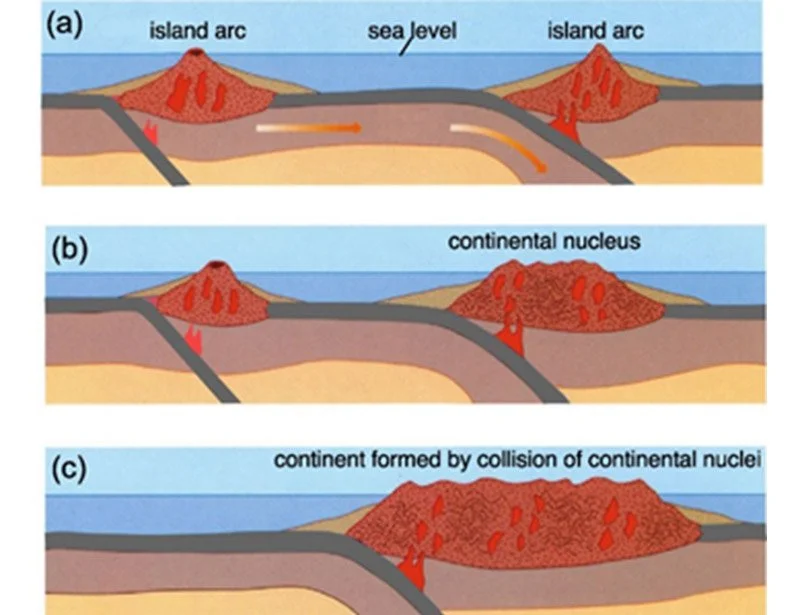
Cartoon showing collision of multiple island arcs, as proposed by Team 2
Instead, here’s what they propose. Imagine an island arc like Japan or the Caribbean, a curved string of volcanos sitting in a shallow sea. Now imagine a second island arc that forms 100 million years later, several miles away but drifting ever closer. Eventually, the younger islands smash into the older islands, squeezing and folding rocks of different ages next to each other. You’d eventually make a super-Japan or super-Caribbean chain, which honestly sounds pretty cool.
Like Team 1, this island-crashing idea is only possible using modern plate tectonics, or at least something similar. Team 2 admits that over 3.6 billion years, it’s impossible to say that Greenland was exactly like a modern trench or island chain. That being said, the modern Earth is a much better analogue than Venus or Mars. But Team 3 would beg to differ.
Part 3: The Alien Planet
Team 3 includes Alexander Webb at the Free University of Berlin, Jiawei Zuo at the University of Hong Kong, and Thomas Muller at the University of Gottingen in Germany. They’re the newest team on the scene, with a big paper in 2020 and several more since. That being said, folks have been arguing for alternate tectonic scenarios on early Earth for decades. We’ll see similar arguments like this in Season 3 for Australia and South Africa.
Let’s start with what all three teams agree on. They all agree that there are older rocks in the south and younger rocks in the north. They also agree that the rocks were made by volcanic islands and seafloor sediments. And that’s it.
Teams 1 and 2 argued for deep-sea trenches, where one tectonic plate smashes sideways into another, just like today. Team 3 claims to have a much simpler solution: no plates, no trenches, just a single, unbroken crust like Mars. Here’s their vision of the ancient world.
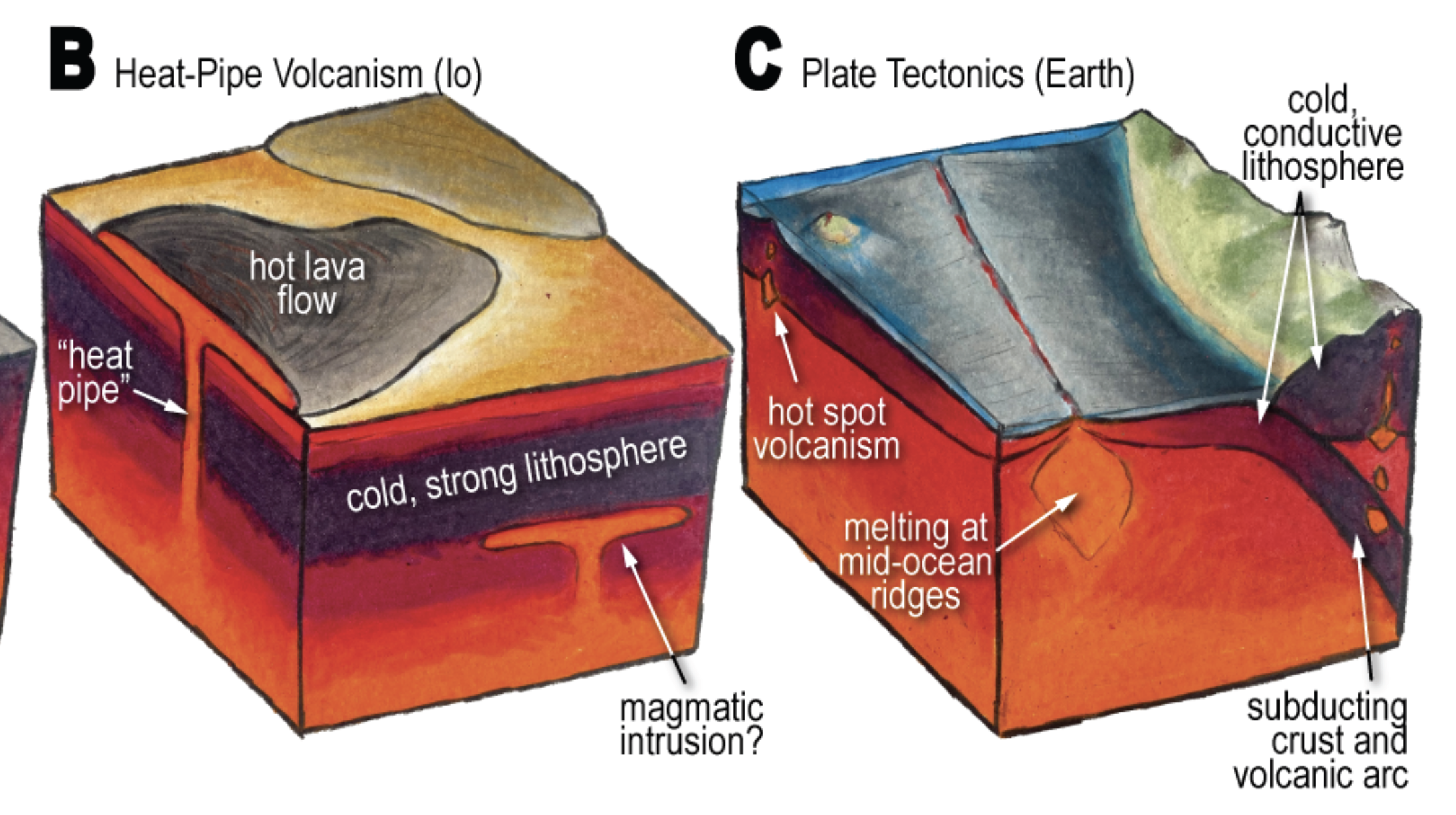
Team 3 propose a vertical “heat pipe” model as shown on left, as opposed to lateral plate tectonics on modern Earth (right). From Keane et al., 2021.
I want you to imagine the Hawaiian Islands, in the middle of the Pacific Ocean. Hawaii is nowhere near any trench, or any plate boundary. Instead, these volcanic islands are forged as hot mantle material rises up from deep below. Let’s keep our imagination focused on this cross-section: the island poking up at the top, underlain by a deep realm of hot mantle.
Imagine that the volcanos keeps erupting. The island will get taller and taller, just like Mauna Kea, which has snow at the top. To balance this high top, the island will also grow deeper and deeper into the mantle, like an iceberg below the waterline. This deeper crust will get hotter and hotter, and eventually melt, forming new fuel for different flavors of magma. Repeat over 100 million years, and you’ll get the old and new rocks in Greenland.
If I just used Hawaii as a comparison, why is this idea so alien? The sheer scale. Even the authors of Team 3 acknowledge you need to erupt titanic amounts of volcanic rock in relatively short amounts of time for this to work. Lava beds 25 kilometers or 10 miles thick within a few million years, more than anything seen on Earth, even ancient Earth.
I try not to show my opinion too early with these comparisons, but heck, it’s late enough. I’m skeptical about this alien, stagnant lid hypothesis. The other teams are as well.
Team 3’s main line of evidence comes from metamorphosis. According to them, the whole region experienced the same level of squeezing and deformation, north and south, east and west. Therefore, this slice of Greenland couldn’t have experienced any trenches, where you would experience different stresses at different points of the collision.
Team 1 and 2 might differ on the direction of stress and strain, north vs south, but they both agree that the region clearly shows varying levels of deformation. Heck, this was an idea we covered way back in Episode 37. Another question is this: if the younger Greenland rocks erupted up through the older rocks, like jelly injected into a donut, you would expect to see those injection marks somewhere. Instead, the older and younger halves are clearly separated into distinct zones. Almost like they smashed into each other side by side.
Team 3 claims their idea is the simplest, removing all those pesky plates and trenches and questions about smashing directions. Instead, it seems to raise more questions than answers. Sure, huge piles of volcanic rock might work on other worlds, but for now, it doesn’t seem to be the case for ancient Greenland.
Once again, we’ve reached the end of another debate, one with twists, turns, and many split hairs. Let’s take a breath, step back, and review the big picture.
Summary
Earth is the only planet with plate tectonics, with a shattered crust shifting around like lily pads. Every other world we know of has a single stagnant lid of crust, peppered with isolated volcanoes like Hawaii, but not broken into pieces. Some folks argue that the early Earth resembled these alien worlds, but in Greenland, 3.9 to 3.6 billion years ago, the landscape seems more familiar. Here, we see evidence for island chains forming alongside trenches, just like the Ring of Fire in the modern Pacific.
Yes, there are still plenty of arguments remaining, including many I couldn’t cover for time. Some teams can’t agree on which direction the trench was pushing. Some teams can’t agree on whether these rocks were island chains or scraped from the bottom of the sea. However, there is a broad consensus in Greenland, more than we’ve seen for other debates. The plate tectonics that shape the modern Earth has been happening for a long, long time.
And so, we say farewell to Greenland, our home for 300 million years and 18 episodes. Whether you found it an epic tale or a bit of a slog, it is done. It could have been even longer, there were many stories I had to leave out. But I’ve learned a bit about pacing that should help things move along in later seasons.
Speaking of which, we are sitting at 3.6 billion years ago, March 19 on the great Earth Calendar. This marks the end of the Eoarchean Era, to focus of Season 2. But you’ll notice that it is not quite the end of Season 2 itself. That’s because I have one more story to tell. Don’t worry, it will only take one episode to tell, but it will be jam-packed with excitement.
This is a breaking news story, released in early 2026. For the final episode of Season 2, we will meet the newly-crowned oldest rocks in the United States of America.