53: The Great Fossil Debate
Hi folks, it’s been a while. If you want to know where I’ve been, please check out the last update episode. The good news: my girlfriend’s medical recovery is going well. The bad news: my time at GVSU has finished, and I’m looking for new jobs. I have a few leads, and if you have any leads, I’m all ears. My email is bedrock.mailbox@gmail.com. It’s tough getting academic jobs in the best of times, and these are not the best of times.
But I’ll leave all that baggage at the door. It’s good to get behind the microphone again. Thanks to everyone for waiting on me, sending me well wishes, or supporting me on Patreon, you are still the best audience out there. It’s always a light in the dark times.
Last time on Bedrock, I left you all on a cliffhanger, one of the biggest debates in modern geology. Let’s recap Episode 52.
In 2016, a team of researchers claimed to find Earth’s oldest visible fossils, the first evidence of life you can see with the naked eye. How old? 3.7 billion years old, or March 11 on the imaginary Earth Calendar. Where? SW Greenland, near the edge of the massive ice sheet. This discovery was revealed as the ice slowly melted away, thanks to climate change. It almost sounds like an old sci-fi movie: scientists discover an ancient fossil hidden beneath melting ice. What they found was not a caveman or a dinosaur or an alien.
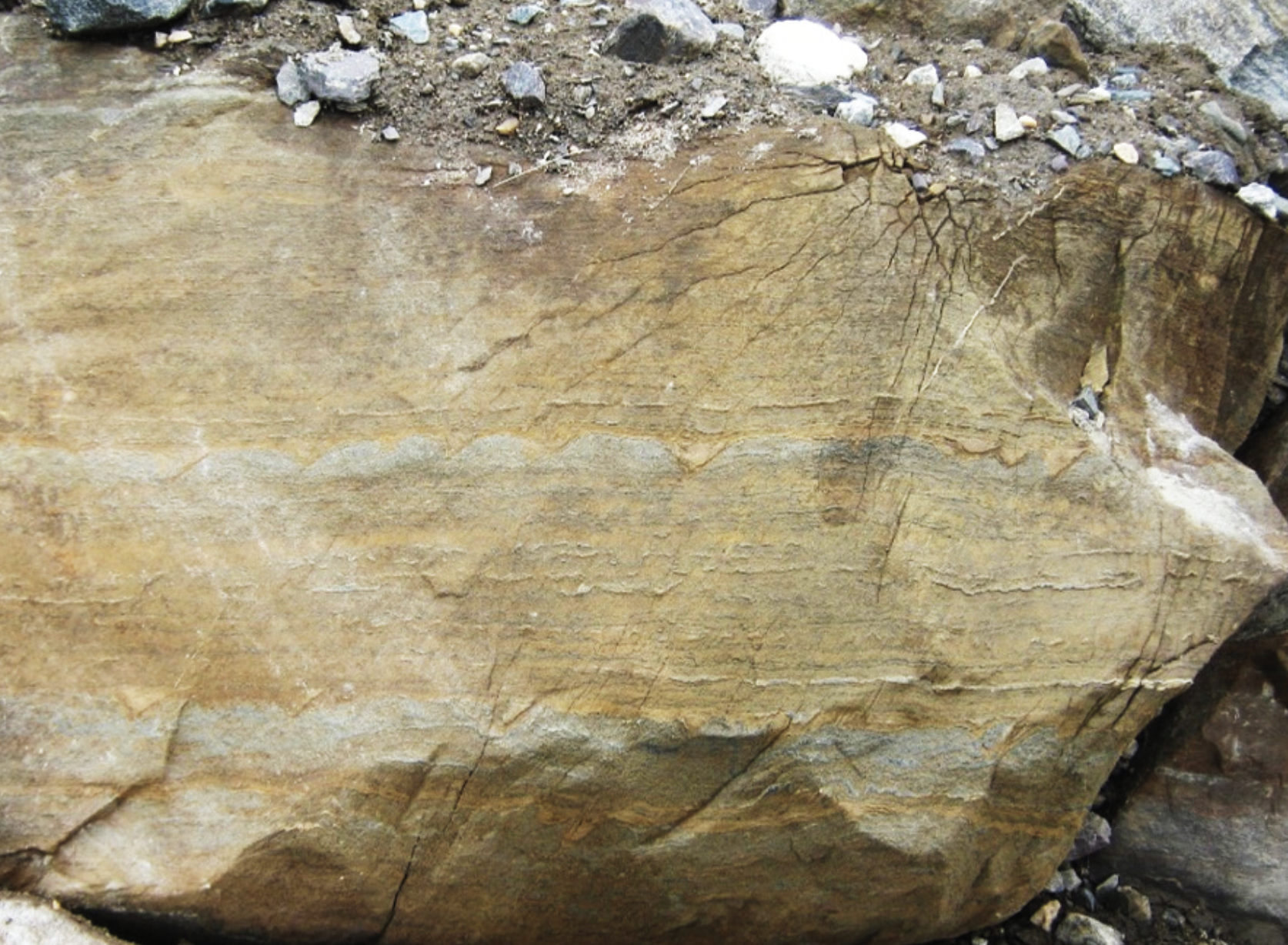
Boulder “A” from the image above, as seen on foot. Note the downward-pointing triangles in the middle gray layer. These are the possible stromatolites in question. If so, the rock has been flipped “upside-down”. The white cobble is roughly hand-sized. From van Kranendonk et al., 2025, Earth-Science Reviews.
So what did they find? What are these possible fossils?
To most folks, they would not look like much. I want you to imagine tan, couch-sized boulders with thin brown layers. Occasionally, these brown layers point downward into upside-down triangles, like vampire fangs or yield signs. The triangles aren’t that big, about thumb sized, but they’ve sparked big debates. Some folks say these small triangles are former microbial colonies: in other words, fossil pond scum. If you want to see these triangles for yourself, check out bedrockpodcast.com
The question is: are these ancient triangles really fossils, or something else entirely? And more importantly, why is this debate important? Who cares about some old pond scum?
Here’s why you should care: until last episode, every fossil candidate has been microscopic: tiny diamonds in Australia, some rusty threads in Canada. Even our first un-challenged fossils from Episode 50 are just tiny crystals of graphite, like pencil shavings.
In Episode 52, we finally got a glimpse of something larger and honestly, more exciting: these strange brown triangles in Greenland. There are two camps arguing over these triangles: Team Fossil and Team Skeptic. If Team Fossil is right, these triangles were once teeming with microbes, a “primordial ooze” that held our early ancestors. If Team Skeptic is right, these are just some messed-up rocks.
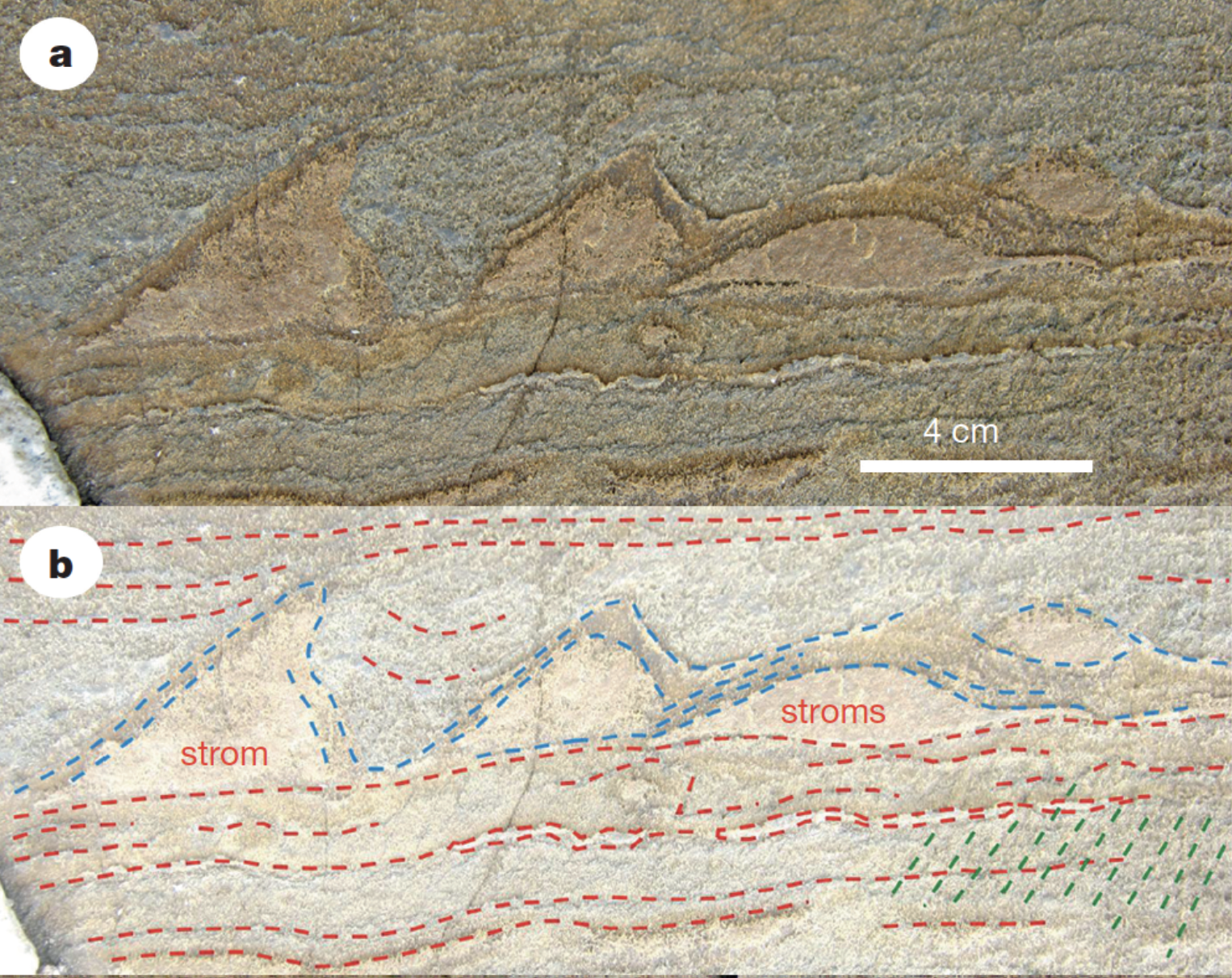
The picture that started the whole debate. This image is from the right side of Boulder A from the figure above, rotated 180 degrees. Nutman et al., 2016.
Today, we examine both sides of this debate, one of the biggest in the fossil world. Instead of our usual three-act structure, I’m going to lay out pieces of evidence like a court case: Exhibit A, B, etc. For each exhibit, we’ll let Team Fossil make their case, then a rebuttal by Team Skeptic. Speaking of which, let’s briefly review our teams. I promise this won’t be a name-fest, but it’s good to give some shout-outs: two folks each.
On Team Fossil, we have Allen Nutman. Nutman has been a constant companion in our Greenland adventures. Whether you agree or disagree with him here, he’s arguably the foremost expert on ancient Greenland rocks. Also on Team Fossil is Martin van Kranendonk, a researcher we’ll see more of next season. If Nutman is the Greenland expert, Martin is the fossil expert, publishing many papers from the Australian Outback.
On Team Skeptic, we have Abigail Allwood. Allwood is also a fossil expert, has also made her name in the Outback, and we will see her more in Season 3. She’s currently a researcher at the Jet Propulsion Laboratory, working on Mars missions. Finally, we have Mike Zawaski, who has published the last few rebuttals. His other projects cover everything from Mars to Incan ruins.
We have our teams, we have our funky little triangles, let’s see if they’re fossils or not. I’m saving my opinion for the very end, and I’m going to keep things entertaining, but civil. I’m friends with folks on both sides, and want to keep it that way. Let the debates begin!
Question 1: Which way were the triangles originally pointing: down, or up?
That might sound like a very silly question to start, but it’s perhaps the most serious.
If the original triangles pointed upwards, they could be fossils. Many future fossils we’ll see form pointed cones or domes rising up from seafloors. If the triangles pointed downwards, they’re almost certainly not fossils. No fossil in Earth’s history makes a similar shape. You might say “But Dylan, perhaps they’re some lifeform we’ve never seen before!” Fair point, but that’s extremely hard to prove, verging into Bigfoot or Loch Ness Monster territory. There are plenty of other arguments to cover without assuming a weirdo, never-before seen fossil. In short, if the triangles point down, they ain’t fossils and this whole debate is done. If they point up, there might be a chance.
If you walk up to these Greenland boulders on foot, you would see the triangles pointing downward. That’s not a great start, but hold on. With rocks this old, there are many ways to squeeze and flip them around. We need to look more closely.
Let’s start with Team Fossil. They claim the triangles originally pointed up, and have been flipped upside-down sometime in the past 3.7 billion years. They claim that nearby rocks in the area are also clearly flipped upside-down. How can they tell?
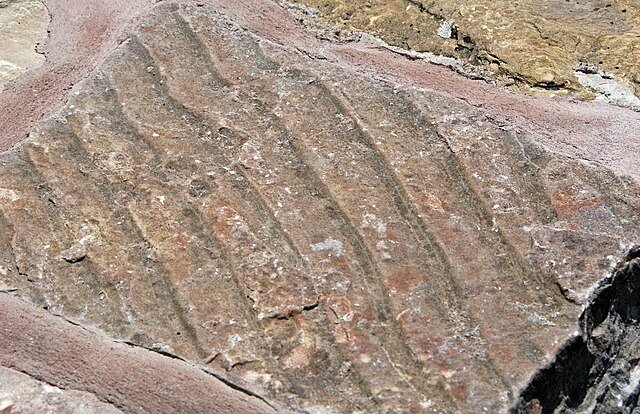
Ripple marks, not from Greenland
Some of these nearby rocks are sedimentary, they formed from loose particles like sand or mud. When sand moves around, it forms unique, curved shapes like ripples or dunes. If you’re lucky, these curved shapes can be preserved for billions of years, and can tell you which way is up. For example, if you find old ripples, the pointy peaks are pointing up. Geologists call these shifted sediments “cross beds”, because they form jaunty angles that “cross” different directions. Cross-beds will be a frequent guest going forward, and we’ll give them more time on a later show.
In addition to cross-beds, Team Fossil also found features in volcanic rocks that point the way up. We’ve seen these features before in Episode 31, they’re called pillow lavas. As lava oozes from the seafloor, it instantly cools in the water, forming lumpy ovals that look like pillows. If you look closely, you can see where the pillow was born deep in the ground, and where it cooled up in the water. They’re very useful for telling up from down.
When Team Fossil looked at their cross-bedded sediments and pillow lavas, they consistently found them flipped upside down. Therefore, the weird brown triangles were also flipped upside down. Therefore, those weird brown triangles could be fossils.
But let’s hear Team Skeptic. The skeptics argue that there’s a lot more folding than meets the eye. To help visualize, grab a piece of paper, or use your imagination. Fold that paper into a downward curve, like a frowny face. This type of folding happens to rocks all the time, especially older ones. Now fold the outer edges back up to make a “W” shape. This is a more complex type of fold, with some parts of the paper pointing up, and others pointing down. It’s also very common to see in older rocks.
Both teams agree that the Greenland rocks have a complex series of folds, like the many folds in our poor paper. However, Team Skeptic argues that the possible fossils, the cross beds, and the pillow lavas are too far away from each other to confirm a unified up direction. These sites are separated by several meters of loose dirt and cracked earth, making things difficult to tell. Furthermore, Team Skeptic isn’t convinced by the cross-bedded sediments. When Team Skeptic re-visited the same sites, they took wider-scale photographs showing extensive cracking and folding that obscures a clean interpretation.
In short, the jury’s out on whether our strange triangles point up or down. Here's the summary before moving on. Team Fossil argues the triangles point up, just like pointy microbial colonies on the seafloor. Team Skeptic argues that we don’t have strong evidence either way, we need more conclusive proof. If the triangles point down, then they’re very hard to explain as fossils.
For our future questions, we’re going to assume the triangles point up, but remember, that could be proven wrong in the future.
Question 2: How altered are these triangles?
Both teams agree that the Greenland rocks have been through the ringer, pressure cooked hundreds of degrees. According to Team Fossil, the strange triangles are former microbial colonies that have been tortured by metamorphism. According to Team Skeptic, the triangles were not made by life at all, but by the pressure-cooking process itself.
Before hearing the arguments, let’s mentally revisit our boulders on the Greenland tundra. Again, I’d highly recommend looking at bedrockpodcast.com to get a visual, otherwise let’s use our imaginations.
Once again, we see a large flat boulder with gray and brown stripes. A few of these stripes point into triangles. For argument’s sake, we’ll say they point up. With any flat rock face like this, you’re only seeing part of the story. It’s a 2D slice of a 3D structure, like a single slice of marble cake, or a single medical scan through your body.
The question is: are these triangles part of larger shapes, hidden in the rock? And if so, what is that shape? If you’re confused, Let me give you a kitchen example.
I want you to imagine two different types of chocolate candy: one is a small cone like a Hershey’s Kiss. The other is a long triangular-shaped tube, like a Toblerone bar. If you cut into the chocolate cone, you’ll make a small brown triangular slice. If you cut into the Toblerone bar, you’ll also make a small brown triangular slice! Two very different 3D shapes can make the same 2D cross-section.
The same idea applies to the Greenland boulders. If the small brown triangles are from cones, they could be fossils! Microbial colonies frequently make cones or domes rising from the seafloor, and so do their fossils. But, if the small brown triangles are from long Toblerone-shaped features, then they probably formed from metamorphosis, not fossils.
Let’s bring this idea back to the Greenland boulders. We have our small brown triangles on the surface, but what does the hidden structure look like inside the rock? Cones, Toblerone bars, or something even weirder?
To answer that question, Team Fossil and Team Skeptic have literally sawn into these ancient boulders to see what’s inside. It’s a risky proposition. Ideally, you don’t want to deface what might be Earth’s oldest fossils with a hand saw. But in this case, you can’t tell if they are fossils without sawing them open. So each team carefully picked spots that minimized the damage, and cut slices out for a full 3D picture.
So what are the larger structures behind the strange triangles? Turns out, there are multiple answers to that question. Different teams found different results.
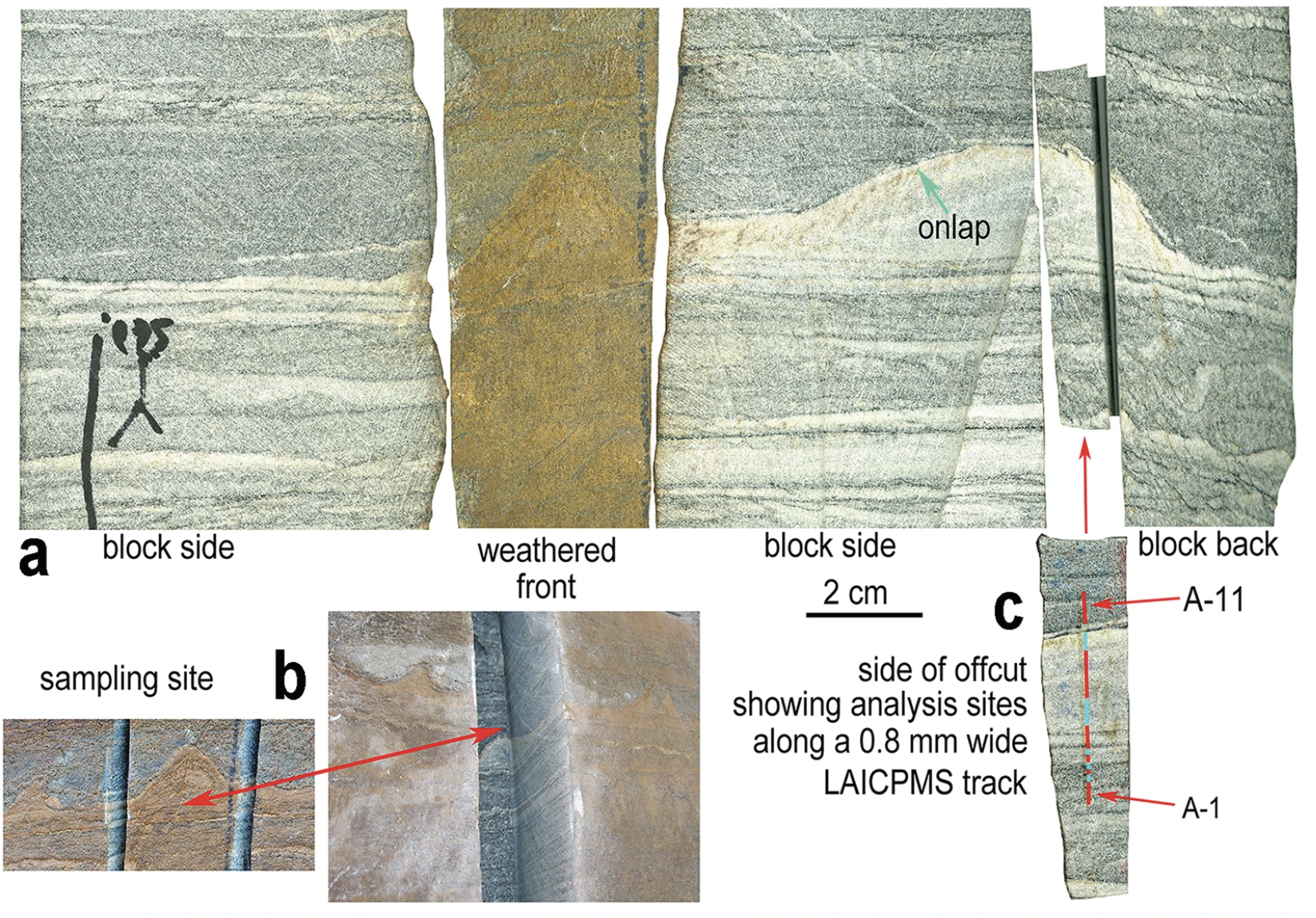
Cross-section from Nutman et al., 2016. Note the stretched-out dome, argued as a fossil.
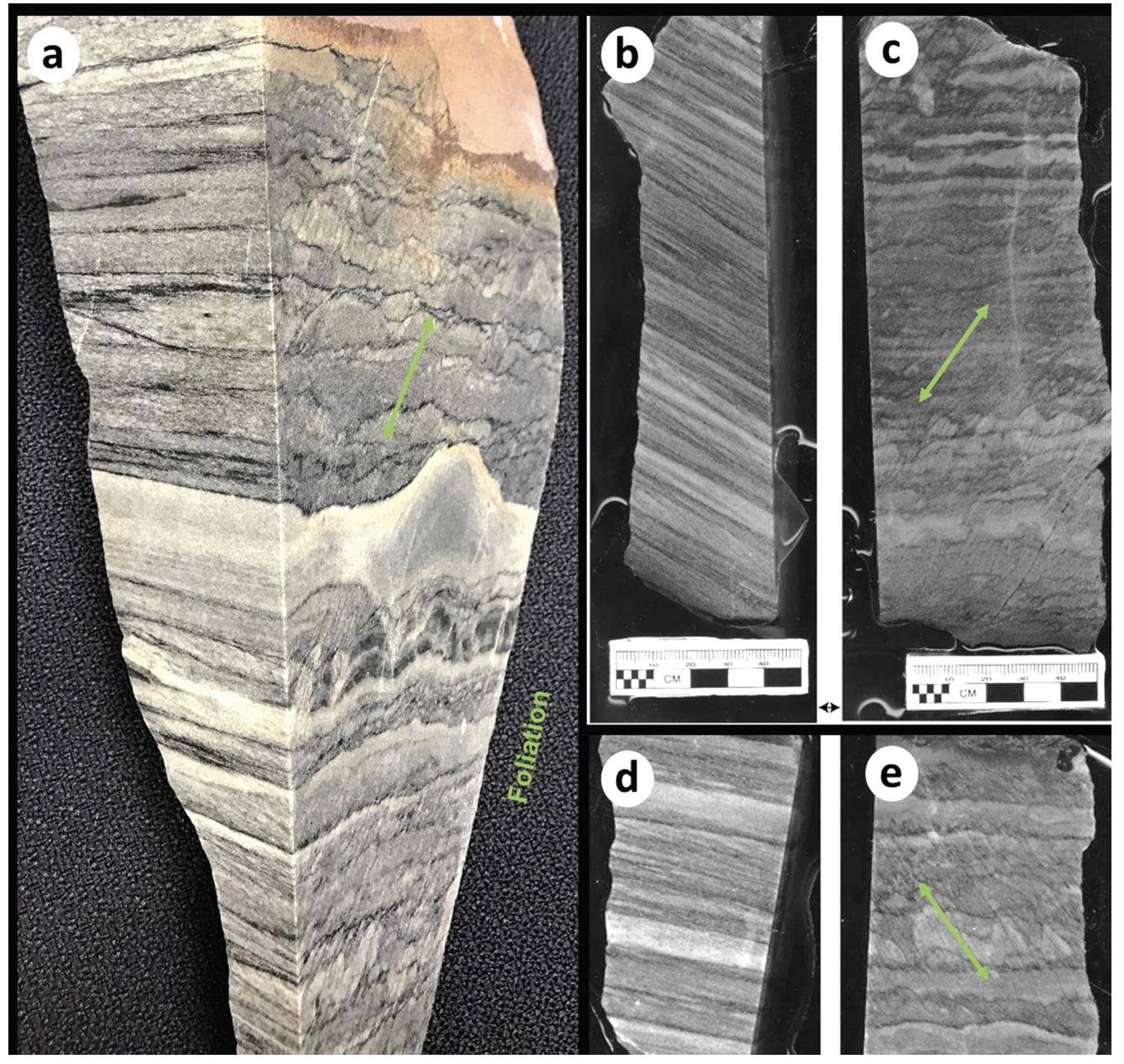
Cross-section from Allwood et al., 2018. Note the straight-back 3D structure, argued as not a fossil
When Team Fossil cut inside, they found domes, like squished chocolate gumdrops or Hersey’s Kisses. And by squished, I mean squished. This doesn’t automatically make them fossils, but it keeps them in the running. When Team Skeptic cut inside, they just found straight triangular rods, the Toblerone bars. If they were fossils, they have been stretched out beyond recognition.
So once again, the jury is at a draw. Sometimes it feels like Team Skeptic and Team Fossil are talking past each other on this point, claiming that their find disproves the other. From my personal view, I can imagine different degrees of stretching and warping, whether these structures were fossils or not. Clearly, we need more evidence.
Question 3: What is the chemistry of these triangles?
This one is a short palate cleanser. After two inconclusive rounds, this question actually has a solid answer that both teams agree on. Shocker!
As we’ve seen time and again, when physical textures fail us, geologists turn to chemistry. I’ll say up front, the chemistry doesn’t prove the weird triangles are fossils. It’s still too early in the show to give the answer away. But they give us a major clue.
Every rock has a specific chemical signature that tells us where it formed. Some rocks tell us they formed inside a magma chamber, others at the bottom of the sea. If we’re looking for Earth’s earliest fossils, we want rocks that formed in water- could be the ocean, a lake, or even a geyser. If our Greenland rocks were forged in lava or metamorphism, they weren’t made by life.
The best chemical toolkit to learn a rock’s origins are rare earth elements. We’ve seen these elements a few times on the show, but here’s a quick summary. Rare earth elements are 17 sisters on the periodic table. They have many similarities, but each has their quirks. Some prefer hot water over cold, some prefer one type of crystal over another. When you measure all 17 rare earth elements in a rock, and line them in a row, you can learn where that rock formed. For more details, check out Episode 27: Rare Earth.
Let’s bring chemistry to our weird Greenland triangles, our possible fossils. When Team Fossil analyzed the triangles, they found a seawater signature. In the interest of time, I’ll describe what that chemical signature is in a later episode. In a word: the rock had more heavy than light elements, especially one element called yttrium. Don’t worry if that’s short, we’ll see this signature many more times going forward. Here’s the important thing:
Our strange little triangles formed at the bottom of the sea, 3.7 billion years ago. This is a great place to make fossils, nearly every fossil we’ll see came from the seafloor. But just because a rock came from the seafloor doesn’t mean it was alive. We need more evidence.
Question 4: How did these triangles interact with the seafloor?
OK, now that we all agree that our strange little triangles formed on the bottom of the sea, it’s time to get nit-picky again. There’s not much else the two teams agree on.
For our next section, let’s start by imagining a sandy seafloor, surrounded by clear, cool blue water. No stress if you’re afraid of the deep, there are no dangerous critters here, 3.7 billion years ago! Now, I want you to imagine a small pebble sticking out of the sand, no bigger than your thumb. Good? Now, imagine that the sand slowly buries the pebble over time, layer by layer. Eventually the pebble is completely buried to the top, no trace left.
Ah, as nice as that meditative exercise was, there was a point to it. This burial process happens on the seafloor all the time, to pebbles and shipwrecks to coral reefs and even pond scum. We see this all the time on the surface, but what does it look like in the rock record? For our imaginary pebble, we would see it embedded in layers of sandstone. Above and below the stone, the sandy layers would be unbroken. But along the sides of the pebble, the layers would stop, like sentences on the edge of a page.
There’s a word for this idea in geology: onlap. Onlap is when layers of sand or mud are interrupted by an object on the seafloor, like pebbles, shipwrecks, or pond scum. I like to remember onlap like waves “lapping” onto the shore, interrupting and coming to a stop.
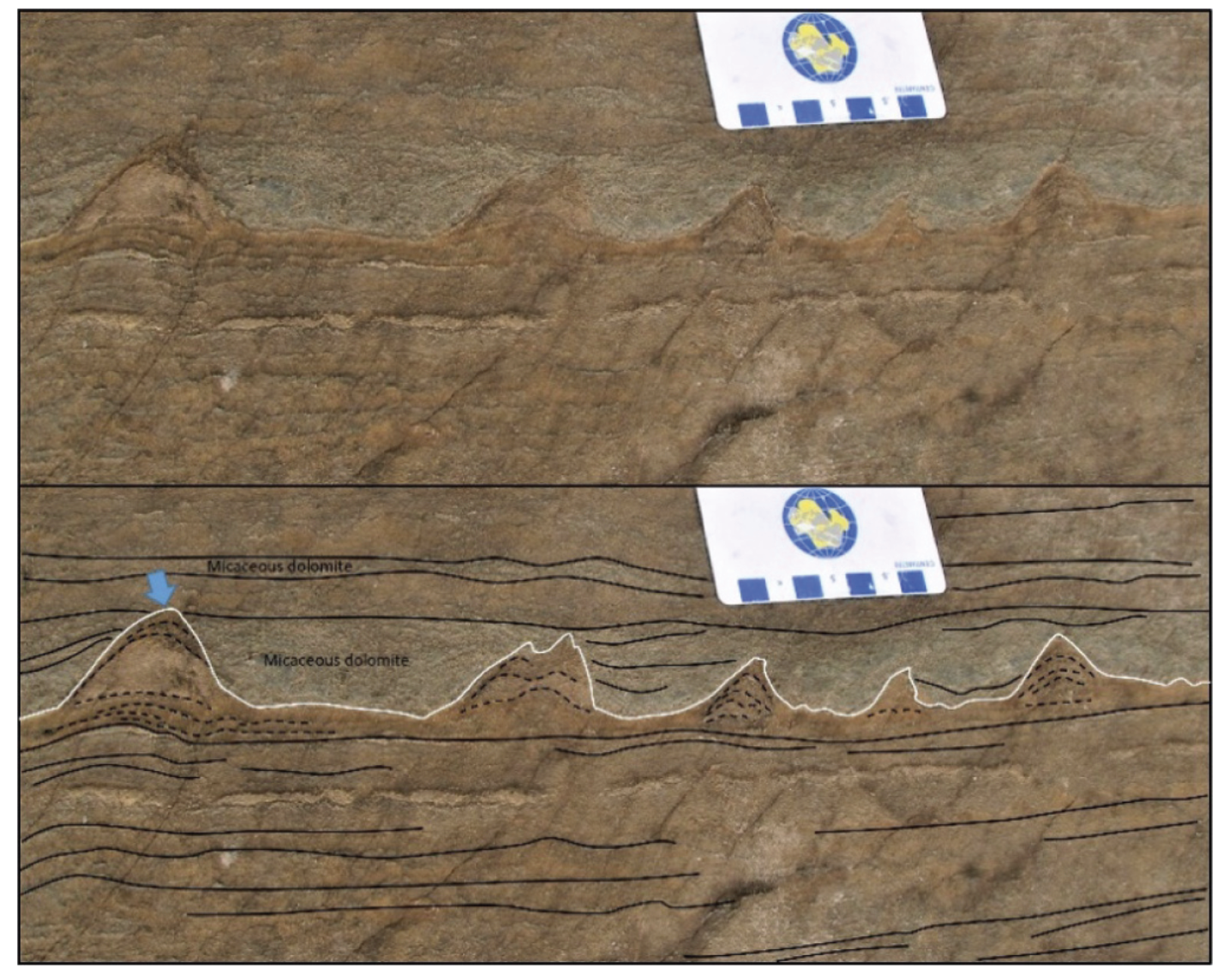
Surface features from van Kranendonk et al., 2025, arguing for fossil microbial colonies, including onlap on the sides of the triangles
Let’s bring this idea back to our funky Greenland triangles. Team Fossil has described several cases of onlap, where layers of seafloor sediment stop dead against the triangles’ edges. According to Team Fossil, this means the structures were once sticking up from the seafloor, like pointy microbial colonies do today. Again, onlap doesn’t definitively prove the triangles are fossils, but it would be a major point in their favor.
Team Skeptic, as usual, has a rebuttal. They claim that with all the stretching, squeezing, and baking the rocks have seen, these cut-off layers might have nothing to do with the original seafloor. Like their previous arguments about cross-beds, there are many ways to make layered rocks. I must confess, I’m not an expert on intense metamorphism. Most rocks I study are far more well-preserved. A few pictures from Team Fossil do look like onlap to me, and I wish Team Skeptic referenced a few more papers or pictures showing alternative pathways. That being said, I’m not entirely on Team Fossil’s side, since there are plenty of non-living features that stick out of the seafloor.
Once again, the jury is out, and we have just one more line of evidence.
Question 5: Do these triangles have internal structure?
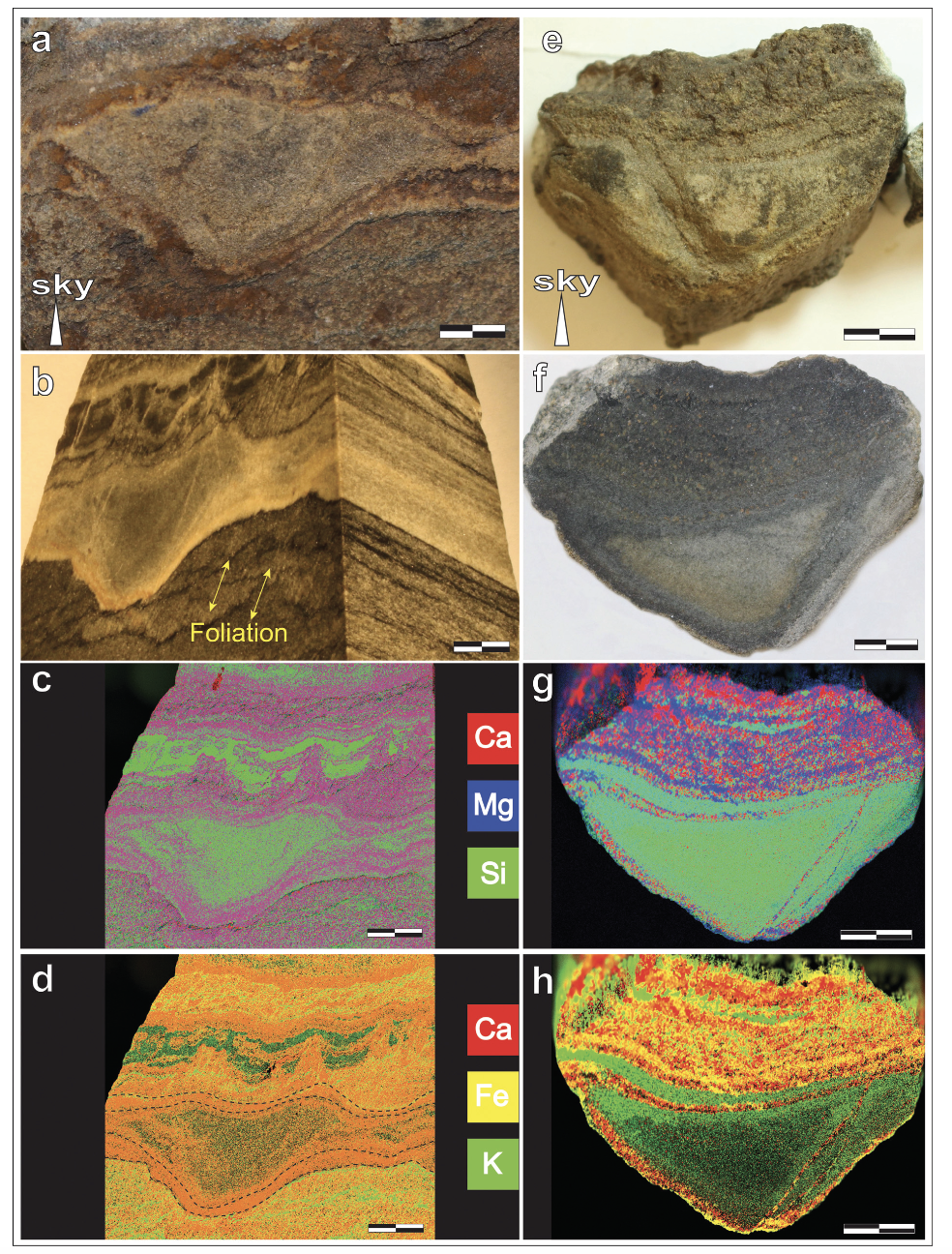
Internal structure (or lack thereof) from Zawaski et al., 2020, argument against fossils
Finally, our last point of debate. We’ve talked about the triangles’ shape and surroundings. But do they have any structure inside? Are they solid, like a block of chocolate, or layered like a cake? Here’s why their insides matter.
If these little guys were once microbial colonies, they should have layers. If you slice into modern pond scum, you’ll see sticky, snotty levels of green, purple, and brown. When this pond scum fossilizes, you see thin, wiggly lines of crystal in their place. (As an aside, we’ll eventually meet a few fossil colonies without layers, but that’s much later, and they look nothing like our Greenland weirdos. Just in case someone was typing in the comments.)
As we’ve noted, not all layered rocks are fossil pond scum. But nearly every piece of fossil pond scum we’ll see will have layers. If our triangular Greenland buddies have layers, that’s a strong start. If they don’t, it’s not great news. So what do we see?
As usual, let’s start with Team Fossil. In their original 2016 paper, they described a few faint layers outlining the triangular peaks. As always, check out bedrockpodcast.com for pictures, but you can draw them for yourself. Using a pencil, draw (or imagine) a simple triangle, pointing up. Now draw one or two lines just over the top peak. Yeah, there are layers here, but only at the top, like icing on a dense cake. For most fossil pond scum, you’ll see thin sheets throughout the entire structure, like a parfait or a baklava or a Kit Kat bar. Clearly I’m hungrier than usual writing this episode.
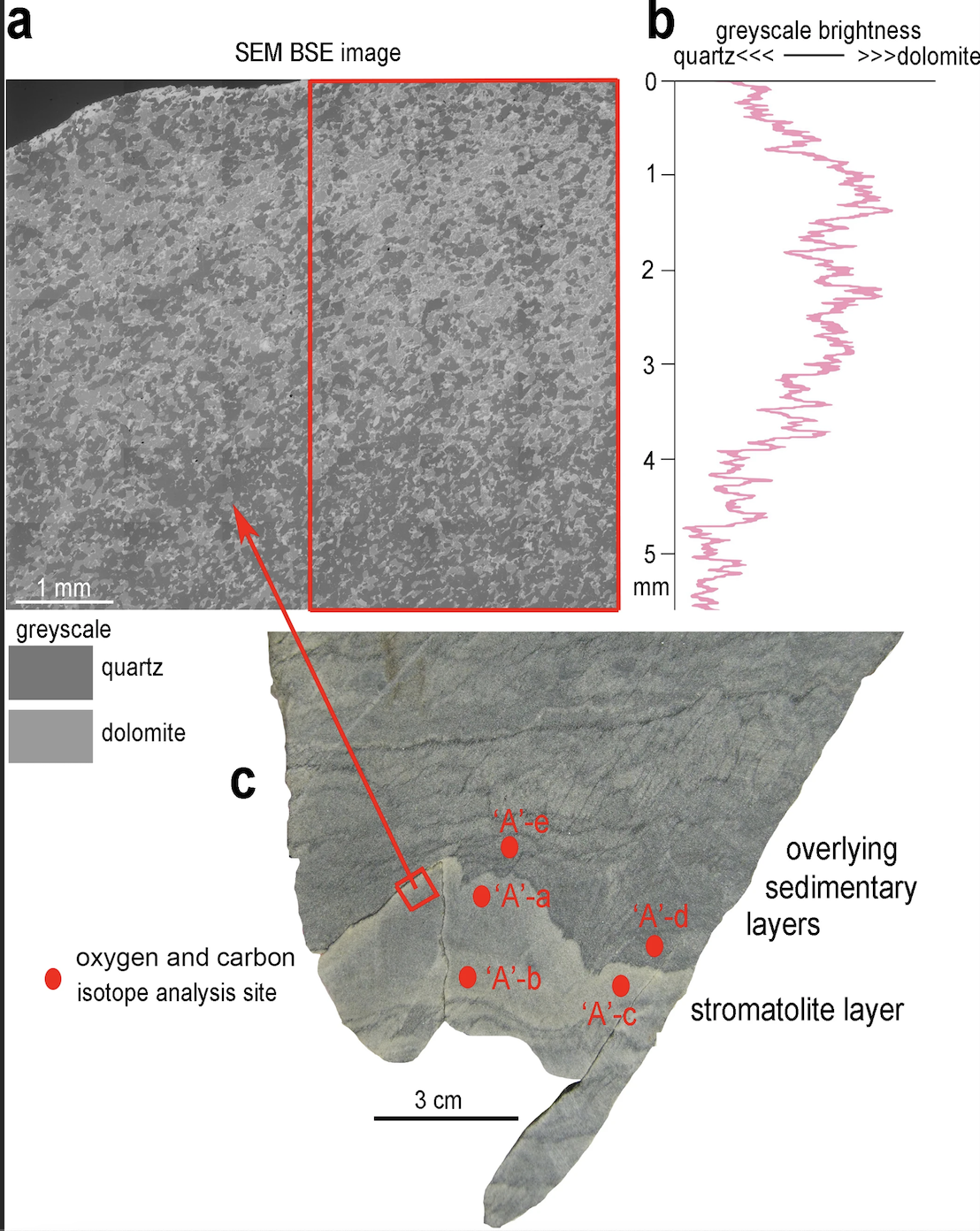
A scan from Nutman et al., 2016, arguing for internal layering. This is the one I mention where I’m very doubtful.
Team Skeptic says these outlining layers aren’t good enough, that we need to see more. The skeptics made chemical maps of the triangles, to see features beyond the naked eye. Still, no internal structure, just solid triangles. Team Skeptic also noted something we commented on in the last argument. Everyone agrees that the rocks above and below the triangles have clear layers. Isn’t it weird that the triangles themselves have fewer, if any layers? Especially if they supposedly formed from sheets of pond scum?
Team Fossil have made a few rebuttals over the years. In 2016, they tried to show that, under just the right microscope, if you blur your eyes and crunch some numbers, there are some vague hints of layers. OK, that was a cheap shot, but I’ve put the picture up on bedrockpodcast.com, around this point in the script. If you can see any layers in that sample, I’ll buy you a drink.
To be fair, there are one or two samples by themselves that might have more structure, as shown in a new 2025 paper. To me, these rare guys look slightly more convincing, and it would be cool to see closer, more detailed images or scans. The 2025 pics are still a bit blurry, no shade to the photographer. I know the publication process can compress photos to more pixelated quality. For now, the jury leans more toward Team Skeptic than Fossil.
Closing Arguments
Phew. I’m beat. That’s a lot of info to cover, and I had to trim a lot for time’s sake.
We’ve broken the arguments piece by piece, let’s hear a short summary from each team. Then, as promised, I’ll weigh in with my personal opinion.
Team Fossil
The brown triangles in Greenland are Earth’s oldest visible fossils, made by microbial colonies on the seafloor 3.7 billion years ago. Why do we think this?
1: The chemistry clearly tells us this was an ocean, a perfect place to find life.
2: The triangles point upward. Many modern colonies form domes and cones of similar shape. We admit the poor little triangles are stretched out, but we picked the least-stretched material to show you.
3: When you look around the triangles, you see layers of sediment gently resting on their flanks, just like we see in modern pond scum.
4: The triangles have internal layering, just like living and fossil pond scum. Many layers are faint, or only appear near triangular peaks, but they are there. The fossils have been cooked, but they are still clearly fossils.
Team Skeptic
There is not enough evidence to say the brown Greenland triangles are fossils. We agree these rocks were once the seafloor, 3.7 billion years ago. However, the fossils were likely not made by life. Why do we think this?
1: We don’t know which way the triangles point. The nearest rocks that point upward are several meters away, separated by loose rubble. Unless we remove the rubble and connect the dots, there isn’t enough data.
2: Team Fossil says you can see layers of ancient seafloor resting on the triangles’ sides. Such layers could also form during metamorphism long after burial, telling us nothing about the old sea.
3: If the triangles were microbial colonies, they should be riddled with thin layers. Most of them are not, with only a faint outline near the top. This is especially strange, since the surrounding rock has tons of layers. If the triangles don’t have convincing layers throughout, they’re probably not fossils.
Instead, the triangles are likely products of disturbance, either the churning of soft seafloor mud or later metamorphosis deep underground.
Now that the Teams have made their cases, I can feel everyone’s eyes on me. I am the resident pond scum expert, after all. Do I think these Greenland weirdos are fossils or not?
If you’re forcing a yes or no answer out of me, I have to say no, for now. Before you cheer or boo me, here’s a more nuanced answer.
Think about all the fossil debates we’ve seen in the last two seasons: diamonds in Australia, rusty straws in Canada, graphite on Akilia Island. For all these cases, there were multiple explanations for their origins. Some involved life, and some did not. As long as there are alternate explanations that don’t need life, any fossil candidate will be in doubt.
For me, there’s no smoking gun that these little brown triangles were once alive, but there’s also no smoking gun yet that they weren’t alive. Both teams agree the rocks were an ancient seafloor stretched and folded over billions of years. Team Fossil argue that the triangles are stretched out fossils, but Team Skeptic has alternate explanations, mostly involving deformation. Conversely, Team Fossil has made some good counterarguments to shoot down some of those skeptical explanations.
Here's my final take. If the Greenland triangles are fossils, what do they tell us about ancient life? Honestly, not much we didn’t already know. Most geologists and biologists agree life was around 3.7 billion years ago. We’ve already seen undebated fossils from elsewhere in Greenland, the little graphite flecks in Episode 50. They aren’t as exciting as today’s triangles, but they’re strong evidence for life. In Episode 23, we learned about LUCA, the hypothetical grandmother of all life. There are no fossils of LUCA, but strong evidence from DNA places her before 4 billion years.
I think of today’s samples like a family photograph that has been stretched beyond the point of recognition. There are faint outlines of what might be family members, but they also might be buildings. If they were people, you can’t see Grandma’s pearl earrings, or your uncle’s gnarly scar, the features and stories that make them interesting. The Greenland triangles are like that. Even if they were fossils, they’re not much more than signposts in the history of life, no real stories to tell. In Season 3, that will all change.
So for now, I’m leaning on the Skeptic side, but I would love to be convinced wrong. As technology improves, and we find more rocks in remote Greenland, the story may be finally decided one way or another. When that happens, you’ll be the first to know. I hope I did due diligence to both sides, I know at least one researcher who’s an active listener. Maybe I’ll have more interviews in later months. For now, it’s time to move on.
Summary
Two boulders sit on the vast Greenland tundra, within sight of the massive looming ice cap. These boulders have strange little lines with strange little triangles, like nothing else we see at the time. Some folks think these triangles are Earth’s oldest visible fossils, the stretched remains of ancient pond scum on an ancient seafloor. Other folks think they have nothing to do with life, and were only formed by deforming rocks. We need folks like Team Fossil, walking to the edge of the map and searching for new discoveries. We also need folks like Team Skeptic to test those discoveries and play devil’s advocate. The Greenland triangles remain one of geology’s biggest debates, and we’re only 10 years in. Who knows what the next 10 years will bring?
In the next one or two episodes, we will finally end our Greenland adventure. We’ll learn why these rocks stop at 3.6 billion years ago, and then we’ll chart our next destination. Season 2 is almost at a close.