49: The Fossil Quest
As we approach the end of Season 2, let’s step back. In Episode 36, I introduced this season’s final setting: the remote tundra of southwest Greenland. Why have we spent so much time here: 13 episodes and counting? First, these rocks cover a lot of time, from 3.9 to 3.6 billion years ago. On our Earth Calendar, that’s nearly a whole month, February 24 to March 15. These rocks are also our largest playground yet, over 3000 km2: the size of Rhode Island or Luxembourg. With all this time and space, we’ve had to divide and conquer, separating the big Greenland storyline into smaller questions. We started large scale with tectonic tales, as islands and continents were built. Then we zoomed in to more local stories. In Episodes 40-42, we visited one of Greenland’s oldest slices, a small corner of a small island where nearly every rock is hotly debated.
Since Episode 43, we’ve focused on another corner of southwest Greenland, younger, and larger: the crown jewel of Season 2. This region is called Isua. Isua a curved smiley face of layered stone stretching miles across the tundra. First, we covered the “lower lip” of this smile, the older half of the rocks. These rocks are mostly igneous, vomited out of volcanos. Then, we shifted to the mid-point of Isua’s smile, the crease between the lips. The dividing line marks a clear boundary between south and north, between older and younger. These dividing rocks are sedimentary, forged in seawater, including our new friend dolomite.

The Isua region, with Season 2 rocks in vivid colors. We’ll be looking at the green and pink rocks in the northern half, ~3.7 billion years old. Nutman et al., 2022, PCR.
Now, it’s time to cross the dividing line to the younger northern Isua rocks, the “upper lip” of this great stone smile. And I’m going to pull the curtain back for a second here. Until now, I’ve been telling Isua’s story chronologically, more or less. With each new layer, we’ve jumped forward in time, from glittering green mantle rocks to dark deep-sea basalts, to pale volcanic ashes, and finally to bratty dolomites.
Now that we’ve crossed the half-way line, I’m going to change the style of our story, for a few reasons. Reason 1: the rocks ahead of us in the “upper lip” are broadly similar to the ones we’ve already seen. There will be more mantle rocks, more basalts, more ash beds and BIFs and dolomites. By strictly following the timeline, I’d be giving twice-told tales.
Reason 2: There is a different story that can be told here. It’s the search for Earth’s oldest fossils. Many researchers have claimed to find the oldest evidence for life on Earth in Isua. Nearly every claim comes from the northern half, the “upper lip”, the rocks we haven’t seen yet. Instead of strictly following the Earth Calendar, this quest for the oldest fossil is better told in order of discovery, from the 1970s to today. I think it’s more interesting to see the science evolve over time, than to quibble over March 9 or 10. For folks who really want the Earth history version in order, I’ll give a recap at the season’s end, in a few episodes.
Today, we begin our quest for Isua fossils. There are many ways to search for these fossils. Some folks look for the bodies themselves, while others look for other remains like altered carbon or traces in stone. I’m going to cover each of these methods today, so we’ll be well-armed for the next few episodes of Greenland discoveries. Consider this a mental toolkit for finding Earth’s oldest life.
Part 1: The Four Clues
When most folks think about finding a fossil, they imagine a bone sticking out of a cliff, a shell in limestone, or a footprint in ancient mud. Unfortunately, we won’t see any bones or feet on this podcast, and shells won’t appear until the very last season. Earth’s oldest life was microscopic, and didn’t have the hard skeletons we’re used to finding. But there are still many ways to search for ancient life in the days before humans or dinosaurs or seashells. If your goal is to find Earth’s oldest fossil, there are not one, not two, but four different clues to look for. That’s four ways to investigate for the oldest life.
Before we start the great Greenland quest, I’m going to list those four fossil clues here. I’m going in order of excitement, from “OK, life was likely here” to “Holy crap, these were once living creatures!”. We’ve already seen three of these four clues at earlier locations. We will see all of them again by the Season’s end.
Clue #1: Indirect Traces

Banded iron formation, Negaunee, Michigan, USA.
Life is messy and leaves many traces behind. These traces aren’t the direct remains of creatures, like bones or teeth or shells, but they tell us life was once here. Think of footprints in the sand. Some critter walked up, did something, then moved on and died somewhere else. But as I said, we won’t see footprints for a long time: bacteria don’t have feet. But bacteria still change the world around them. Sometimes they even make rocks.
We’ve already met two such rocks. One is banded iron formation, or BIF. The other rock is our newest friend, dolomite. Each of these stones can be made by bacteria. If you want more details, check out Episode 32 for BIF, and 48 for dolomite. Bacteria do not make such rocks intentionally. Just like the tracks of a wild animal, these rocks are by-products of life. No thought or plan went into their construction. Furthermore, these rocks usually do not hold the original bodies of their microbial creators. If you’re holding a BIF, you’re not holding the remains of a dead critter, just its’ leftovers.
Here's the most important thing to remember about these indirect traces of life. Rocks like BIF and dolomite can be made by bacteria, BUT they can also be made without bacteria. There’s more than one recipe for these stones. Holding a dolomite alone is not enough to prove life was around, you need more evidence. Again, check out Episodes 32 and 48 for more detailed debates. If we need more evidence, let’s move on to…
Clue #2: Organic Carbon
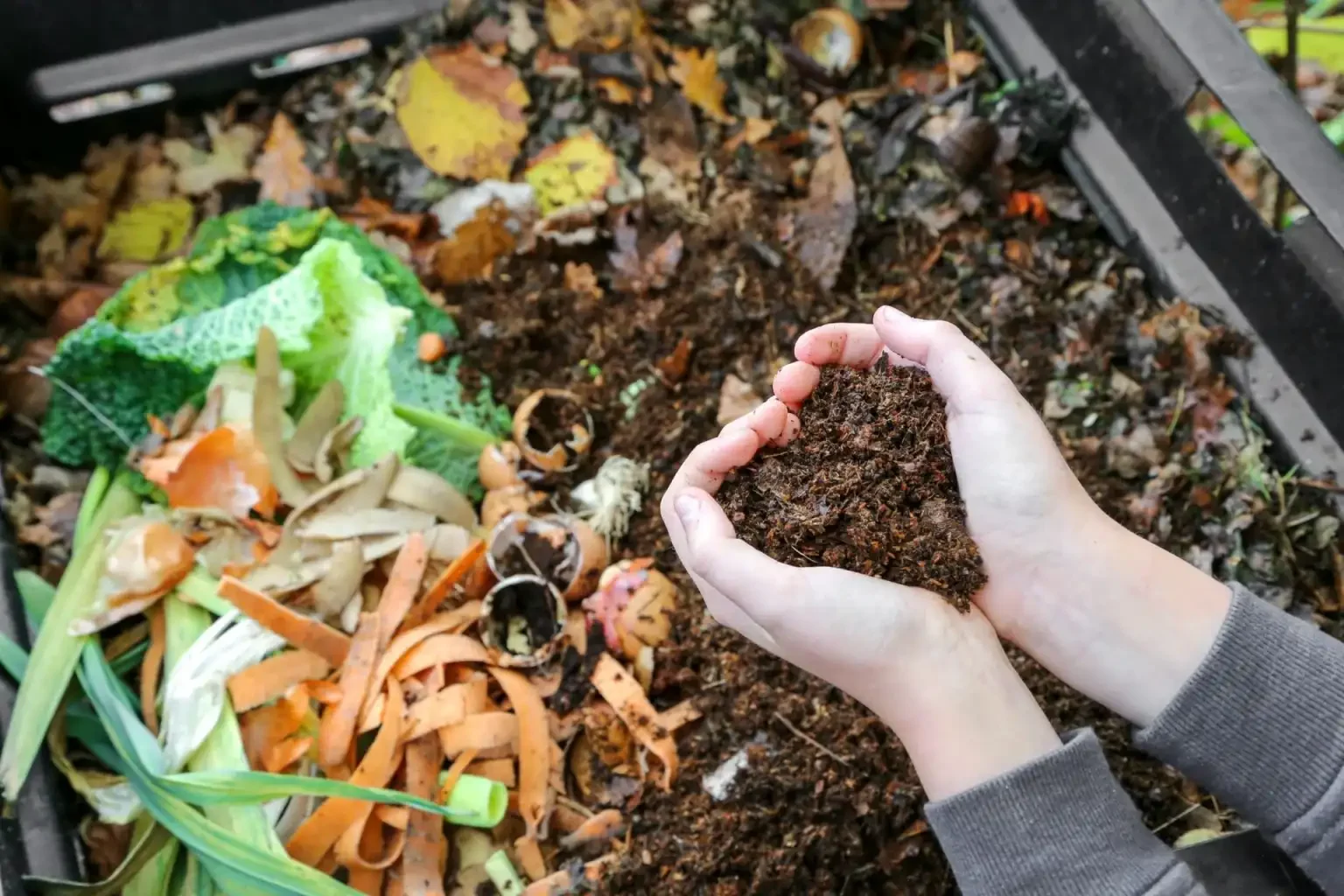
Compost: classic organic matter, biologically and agriculturally. The Tree Center.
Most life on Earth does not become a fossil. Consider a dead log in the forest. If you just leave that log on the surface, it will rot and recycle away into the bodies of mushrooms, insects, and moss. There’s nothing left to preserve. If you bury that log immediately, it decays much slower and has a better chance to become a beautiful fossil tree. Now let’s imagine a half-way point between these two stages: the tree has decayed beyond the point of recognition, but there’s still some material remaining, some old tree crud. If you bury these half-eaten remains, you won’t make a perfect tree fossil, but you’ll still find some material preserved in the rocks. Depending on how long it sits, this buried gunk can be brown to black, and usually has some earthy aroma. There’s a name for this gunk: it’s called organic matter.
Long-time listeners have heard that word “organic” before, we covered it when we were first looking for life. The word “organic” means different things to different people. For most folks, “organic” is a supermarket word: food with no pesticides or preservatives. That’s not what we’re talking about today. In Episode 18, I gave you the strict chemical definition of “organic”: a molecule with carbon attached to hydrogen or another carbon. The chemical definition doesn’t care if life made it or not.
Today, let’s learn the biological definition of “organic matter”, which does care about life. There are three rules. 1: Organic matter comes from a living thing. 2: It isn’t alive by itself. 3: It has a lot of carbon inside. To rephase those rules in one concrete idea: organic matter is a non-living, carbon-rich product of life. That might sound very specific, but once you start looking, you’ll find it everywhere. If you get a haircut, the hair on the barber floor is organic matter. It came from you, it’s not alive by itself, and it’s carbon-rich. Your nail clippings and skin flakes, snot, earwax, and excrement are all organic matter. A dead creature or plant is also organic matter: the entire body came from something living, but it's no longer alive, and has a lot of carbon inside.
All these dead bodies and waste sound nasty, but if you think about it: our diets are mostly organic matter. Every ingredient in a hamburger is organic matter, from the wheat buns to the lettuce leaves to the meat patty- even the ketchup and mustard. McDonalds is organic in the biological sense, just not the cultural sense.

In nature, most organic matter is not made of crisp leaves or meat patties. It’s usually a dark, smelly slurry inside dirt or ocean mud, the processed remains and leftovers of countless living things. Organic matter comes directly from life, but it doesn’t make for exciting, dramatic fossils. This slurry is altered even more during burial, as pressures and temperatures rise. If you cook organic matter just right, you’ll make oil or coal. Keep turning up the heat, and you’ll make another dark material, an old friend of the show: graphite.
If you’re holding a pencil, you’re looking at graphite: pure carbon in crystal form. It’s a far cry from a dinosaur fossil, or even a bacteria fossil, but it still likely came from life. The next time you write something down, remember: you’re using the processed, cooked remains of countless ancient creatures to make your grocery list.
But there’s a catch. Graphite is usually made by cooking organic matter, but there are alternative recipes that don’t need life. All you need is the right combination of carbon and heat, a recipe that can be made deep below our feet. We’ll learn more about these non-living graphite recipes soon, but here’s the gist. The carbon in a very ancient rock can either come from a dead critter, or from a cruel trick of chemistry. As with Clue #1: carbon alone is not enough. For more info about graphite, check out Episodes 16 and 42.
Option 3: Microfossils
Finally! We’ve spent so long talking about traces and leftovers and sludge, let’s get to the good stuff: the bodies. A microfossil is the preserved body of a microscopic organism. It’s a broad term that covers a lot of life. In more recent rocks, microfossils include marine plankton, tree pollen, and tiny pieces of other critters. On this show, we’ll almost always be referring to bacteria and their cousins until the later seasons.
Just how small is a bacteria? Let’s start with a human hair and work downward. A single hair is 100 microns wide, about the limit of the naked eye. Ten times smaller than that, we get into the realm of pollen, dust, and human cells. Ten times smaller than that, we finally get into the realm of bacteria. An average bacteria is around 1 to 5 microns long. For a more intuitive scale, if a hair was as wide as a football field (US or international), a bacteria would be human or car sized.
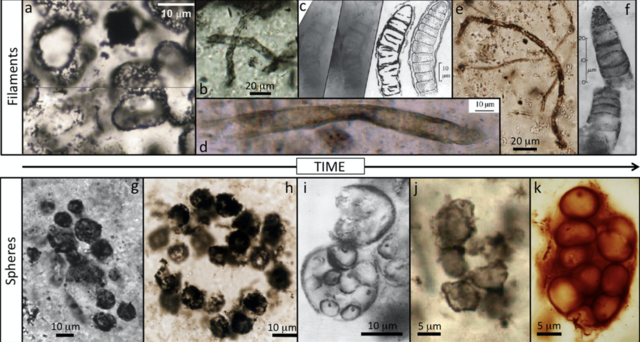
Microfossil examples from many ancient rocks
Bacteria and their cousins come in a variety of forms, but can broadly be lumped into three shapes: balls, rods, and strings. Unlike plants or animals, these shapes don’t tell us anything about their classification. For example: two rod-shaped bacteria could look identical under the microscope, but they could be completely unrelated, as distant cousins as you and an oak tree. One rod could use sunlight as an energy source; the other rod might use sulfur. On the other hand, two close siblings might look completely different. Some bacteria even change shape depending on their surroundings. In short, you can’t usually tell what job a bacteria has just by shape alone. This idea will show up in future episodes.
The simplicity of microbial shapes has another problem. It’s easy for life to make ball, rod, or string shapes. It’s also easy for non-living things to make these shapes. In Episode 33, we examined microscopic structures from Nuvvuagittuq in northern Quebec. These features looked like rusty soda straws: thin, hollow cylinders of tiny red crystals. These straws were the right size and shape as modern iron-loving bacteria. Today, these bacteria are also dusted in rust like an old pipe. But there are other ways to make similar shapes: strange combinations of iron and acid that form near deep-sea vents. For more info, check out Episode 33. We will see similar debates soon: someone finds a small weird shape, and claims it’s the oldest fossil. Someone else comes along and says maybe, but here’s another way to make it. I had a great discussion on these pseudo-fossils with Dr. Joti Rouillard in Season 1. Just search for “Fossil Imposters” on this podcast.
In other words, shape alone is not enough to argue for a microfossil, more evidence is needed. And even if you convince everyone you have a real fossilized bacteria, you need even more evidence to say what kind of bacteria: a sulfur lover, an iron lover, etc. It’s maddening, but we need to be vigilant in our quest for the oldest fossil.
Option 4: Big Fossils
If bacteria are the only game in town this early in Earth history, how can we make a bigger fossil, one we can see with the naked eye? Bacteria are the smallest life forms on Earth, and have no bones, no teeth, no shells, no scales, no leaves or wood. But bacteria do have two things on their side, two properties that can make fossils you can see: numbers and chemistry.
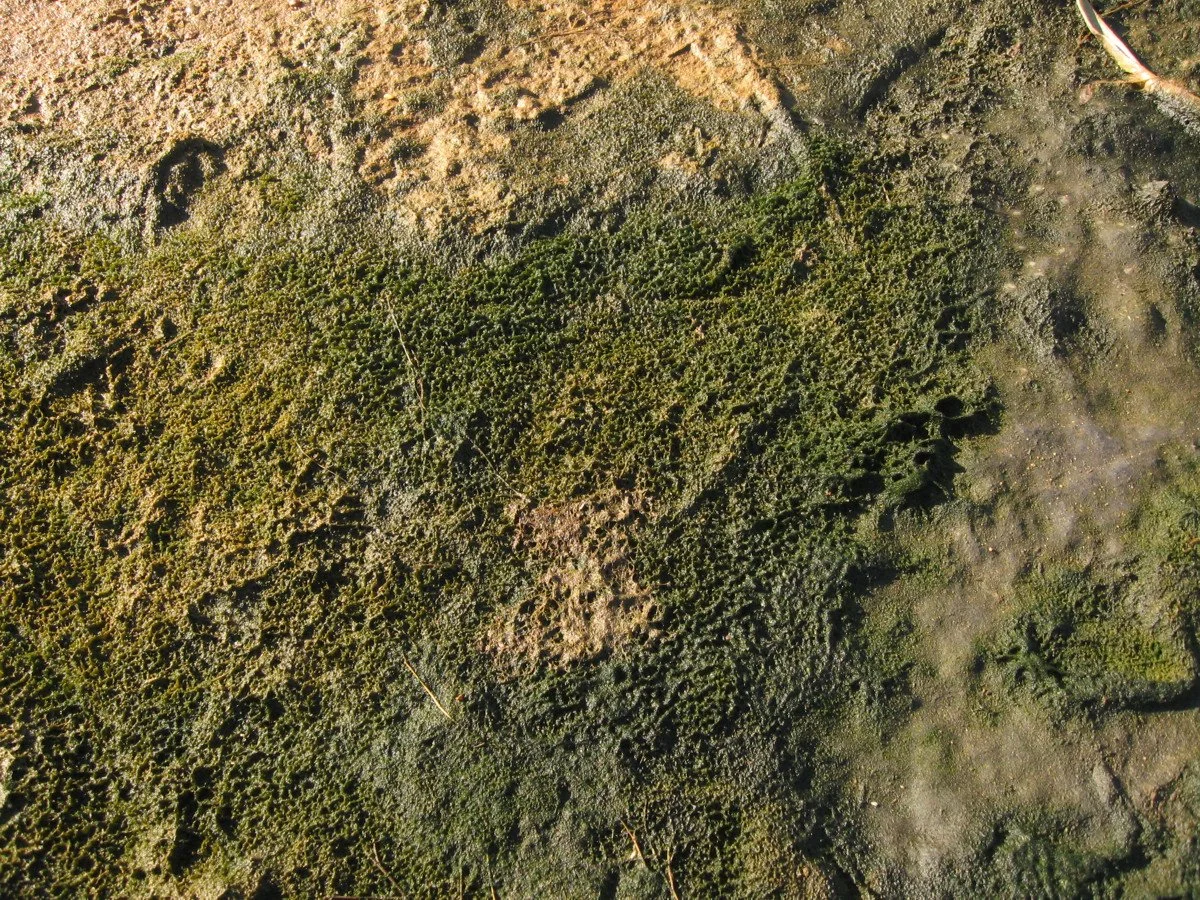
Top-down view of a microbial mat, ~1 meter wide, White Sea, Russia
A single bacteria is invisible. 100 bacteria lined end to end would be just barely visible. But when you gather trillions upon trillions of bacteria together, you can see their colonies as clear as day. In Episode 1, I introduced myself as a specialist in this field, and after nearly 50 episodes, I’m delighted to finally talk about pond scum. When I tell folks I work on “fossil pond scum”, it’s a fun conversation starter, an easy shorthand to get us all on the same page. But there’s a more official name for these colonies: microbial mats. To most folks, a microbial mat looks a bit gross: a slimy multicolored carpet. You can find mats on the shores of many lakes, ponds, and seas, sitting on the sand or floating on the water. If you cut into one, you’ll see thin, wrinkled layers of green, orange, purple, and black.
On a microscopic level, these microbial mats are miniature jungles, teeming with diverse life. Some bacteria act like trees in the upper layers, larger, greener, turning sunlight into oxygen. A few act like tigers, hunting down and eating other microbes in the lower, darker layers. Many behave like worms or beetles, recycling the organic matter that falls from above. Many more bacteria play roles that don’t match anything in a larger jungle: creatures that eat rust or exhale laughing gas. Imagine shrinking the Amazon rainforest to a few square feet, and you can begin to imagine the world of a microbial mat.

Stromatolite cross-section showing microbial layers over time, W. Australia.
How does this tiny, slimy ecosystem become fossilized? Remember, no bones, no shells. If sheer numbers make microscopic bacteria visible as a mat, it’s chemistry that turns them into stone. Sometimes, crystals can directly form in seawater, like sugar crystals in rock candy. Other times, this process can be boosted by bacteria themselves, as we saw with Clue #1. Unlike Clue #1, these new rocks directly form around the messy, crinkly layers of the original microbial mats. Such messy biology forms intricate, baroque features that are rarely preserved in non-living sediments. In other words, these new, layered rocks directly preserve microbial mats as fossilized pond scum.
There’s a special name for pond scum fossils: they’re called stromatolites, or stroms for short. In ancient Greek, “stromato-” means layered, and “lite” means rock. Many rocks have layers, but the layers inside stromatolites usually have a crinkled texture, rising and falling in broad domes or pointed cones. There are other names for other microbial fossils, but the vast majority are stromatolites. I am a strom researcher, and it feels great to finally be talking about them, especially after so many episodes. We haven’t seen any yet, but they will become the fossil stars of the show: the first tangible remains of life you can hold in your hand and see the biology for yourself.
As much as I love stromatolites, they can have their own pitfalls, just like all the other clues in this list. As unique as their shapes can be, there are other ways to form similar domes and cones in nature without life. Just finding a weird layered dome by itself is not enough to say it’s a fossil. And if you find a real stromatolite, you usually won’t find any microfossils of bacteria inside, even though there were once trillions of cells here. As the layers of slime turn to stone, many individual bacteria either rot into loose organic matter, or become obliterated by growing crystals, tearing their tiny bodies apart. Incredibly fast preservation is the best way to make microfossils, like flies trapped in amber. When we see them, it will be a beautiful sight.
I could go on about stromatolites for hours, and will do so in future episodes, but that’s a good summary for now. My initial plan for this episode was to briefly cover the four fossil clues, then jump into the Greenland story, but I think this is a good place to stop for now. I’ll summarize the four once more in just a second. Next episode, we’ll start from the top in 1975, armed with our toolkit of fossil clues. Over 50 years, we’ll see circumstantial rocks, organic carbon, microscopic shapes and crinkled stones. Are any of them Earth’s oldest fossil? Stay tuned to find out.
Summary
Earth’s oldest life was not people or dinosaurs or even sponges, it was bacteria. These bacteria don’t leave dramatic bones behind, but they still give us traces of their existence. There are four ways to search for Earth’s oldest life, some circumstantial, some direct. 1: Some rocks can be made by microbes indirectly, like dolomite or BIF. 2: Life’s decaying remains can turn into dark organic matter, cooked into graphite crystals. 3: If you’re lucky, you can find individual fossil microbes under the microscope. 4: Larger microbial mats can turn into stone, becoming beautiful, layered stromatolites.
None of these clues is enough to prove a fossil by itself. Each clue can also be made by non-living processes, whether rock or carbon, tiny shapes or layered stone. To prove you have a fossil, you must go the extra mile and show that nothing else could have made your rock except life. We’ve seen these debates before, and will see many more to come. Next episode, we start our quest for Greenland fossils in the 1970s, when researchers find some tiny, weird shapes 3.7 billion years old.